
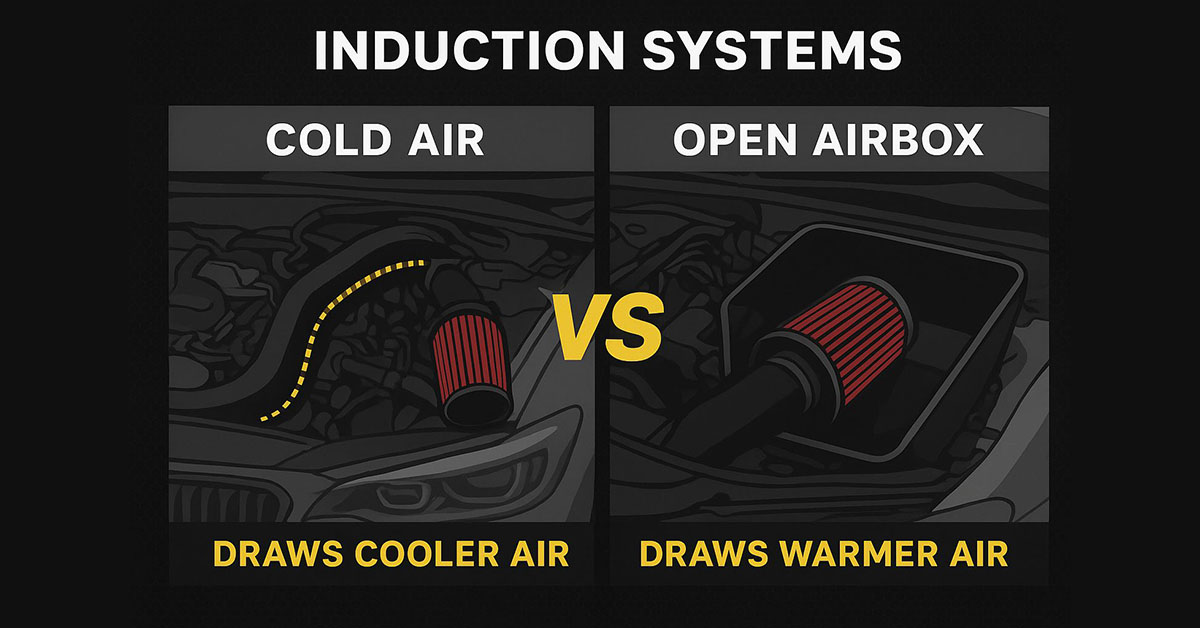
Tech Talk -Cold Air Induction (Intake system) vs Open Air Box Induction System

Tech Talk: Cold-Air Intake vs Open-Air Intake System
One of the questions we receive most frequently is:
Which intake system is better—a sealed cold-air intake or an open-air intake?
The answer depends on what you want from your vehicle.
Some drivers prioritise consistent performance and lower intake temperatures. Others want louder induction noise and a more noticeable turbo-spool sound.
Before comparing the two systems, it helps to understand why intake-air temperature matters.
Why Colder Air Matters
Cooler air is denser than warmer air, which means it contains more oxygen within the same volume.
More available oxygen can support more efficient combustion and improved performance when the vehicle’s engine management and tuning are configured to take advantage of it.
Lower intake temperatures can also help the engine produce more consistent power during repeated acceleration runs or demanding driving conditions.
This is especially important in turbocharged performance vehicles, where under-bonnet temperatures can rise significantly.
What Is a Sealed Cold-Air Intake?
A cold-air intake normally surrounds the air filter with a sealed or enclosed airbox. The system draws cooler air from outside the engine compartment through a dedicated air duct or factory air-feed location.
By separating the filter from heat generated inside the engine bay, the system can help maintain lower and more stable intake-air temperatures.
Improved Heat Management
After repeated acceleration runs, extended driving or time spent in traffic, heat builds up inside the engine bay. This condition is commonly referred to as heat soak.
A properly designed sealed intake helps limit the amount of hot engine-bay air entering the system.
Maintaining cooler intake temperatures can help the vehicle deliver more consistent performance between runs.
Consistent Real-World Performance
Peak dynamometer figures only tell part of the story.
A vehicle may perform well during one controlled test but lose power as temperatures rise. A sealed cold-air system is generally better suited to managing these changing conditions.
This can make it a stronger choice for vehicles used in:
- Drag racing
- Track driving
- Repeated acceleration runs
- High-performance street applications
- Hot South African driving conditions
Cold-Air Intake Advantages
- Lower intake-air temperatures
- Improved resistance to heat soak
- More consistent performance
- Better suited to demanding applications
- Reduced exposure to hot engine-bay air
Cold-Air Intake Considerations
- Often more expensive than an open system
- The enclosed design may reduce induction and turbo sounds
- Installation can sometimes be more involved
What Is an Open-Air Intake?
An open-air intake uses an exposed filter positioned inside the engine compartment, usually without a fully sealed enclosure.
Because the filter is less restricted by an airbox, an open system can produce a louder and more dramatic induction sound.
Turbocharged vehicles may also deliver more noticeable spool, suction and diverter-valve sounds.
Heat Management with an Open Intake
The main consideration is the filter’s exposure to engine-bay temperatures.
When the vehicle is stationary or moving slowly, the open filter may draw in warmer air surrounding the engine. As temperatures increase, the engine management system may adjust ignition timing or other parameters to protect the engine.
This can reduce performance consistency under heat-soaked conditions.
However, the effectiveness of an open system depends on its overall design. Heat shields, air guides and access to external airflow can all influence how well it manages intake temperatures.
Not every open intake performs identically.
Dyno Figures vs Real-World Conditions
A cold-air intake and an open-air intake may produce similar peak figures during a short dyno run.
Those results do not always show how each system will perform after repeated runs, in slow-moving traffic or once engine-bay temperatures have increased.
When evaluating an intake, it is important to consider more than the highest horsepower figure.
Intake temperature, consistency, airflow, vehicle speed and the intended use of the car all matter.
For competitive driving, even a small loss in performance between runs can make a meaningful difference.
Open-Air Intake Advantages
- Louder induction noise
- More noticeable turbo-spool sounds
- Often less expensive
- Visually striking engine-bay appearance
- Can offer strong airflow when properly designed
Open-Air Intake Considerations
- Greater exposure to engine-bay heat
- Potentially higher intake-air temperatures
- Performance may become less consistent during heat soak
- Results depend heavily on heat shielding and airflow design
Which Intake Is Right for You?
There is no single intake system that is perfect for every driver.
If your priority is lower intake temperatures, consistent power and dependable performance during demanding use, a properly designed sealed cold-air intake will generally be the stronger option.
If your priority is louder turbo and induction sounds, an open-air intake may provide the experience you want.
The right choice depends on:
- Your vehicle and engine platform
- Current and planned modifications
- Whether the car is used on the road, drag strip or racetrack
- Your performance targets
- How important induction sound is to you
- Your available budget
At NV Performance, we can help you select an intake system that suits your vehicle, driving style and performance goals.
For professional advice, product enquiries or installation bookings, email sales@nvperformance.co.za or contact us on 078 127 6384.

 <Armaspeed Cold Air Intake System

<Armaspeed Open Box Intake System